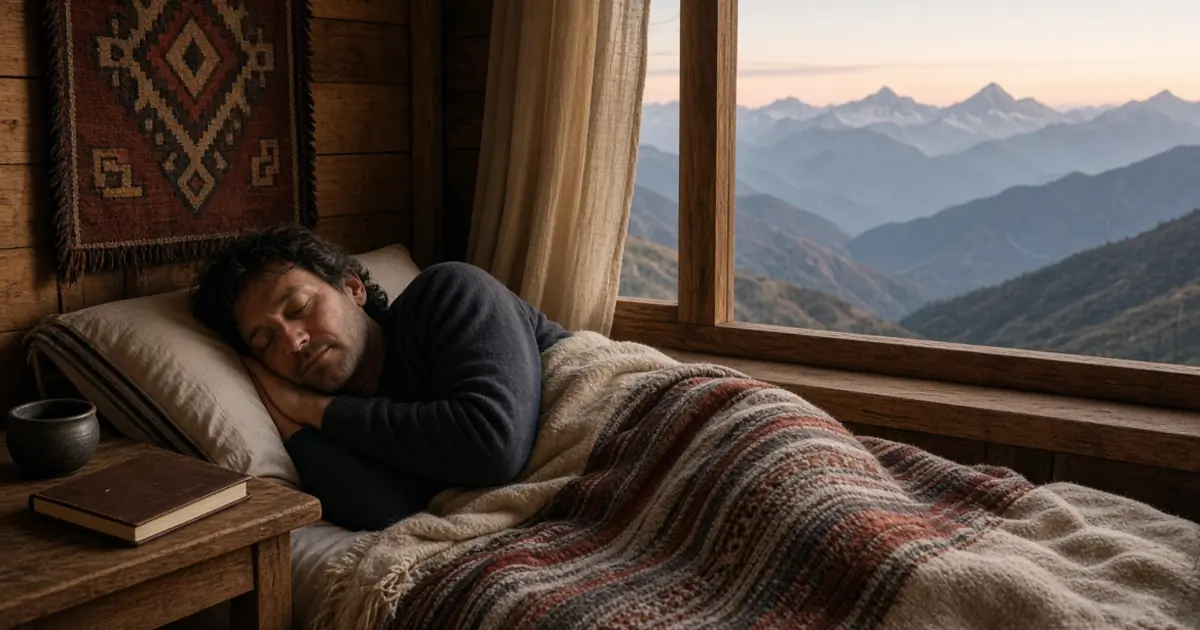
Ayahuasca is not a sleep treatment. The only sleep study ever run on it found the opposite of what most retreat websites claim.
That study measured REM sleep going down, not up.
What ayahuasca may do is work on the anxiety and the depression that keep people awake. That’s a different claim, and it’s the honest one.

What The Research Actually Found
One study has measured ayahuasca’s effect on sleep with electrodes. One.
Barbanoj and Riba’s team in Barcelona gave 22 healthy men a dose equivalent to 1 mg of DMT per kilogram of body weight, then ran full polysomnography overnight. It was published in Psychopharmacology in 2008. Here is what it found.
Ayahuasca inhibited REM sleep. Duration went down in absolute minutes and as a share of total sleep time. Time to the first REM period trended longer.
Slow-wave sleep power in the first cycle of the night went up. That’s the pressure marker for deep sleep. A stimulant control in the same study pushed it the other way.
And sleep quality did not get worse. No delayed sleep onset, no broken sleep maintenance, no drop in how well the subjects said they slept.
So the picture is mixed, specific, and not what you have been reading. Search “ayahuasca and REM sleep” and you’ll find page after page claiming ayahuasca increases REM and produces vivid dreams. The measurement says the opposite. Those pages cite nothing, which is how the error survives.
Two things that study does not tell you. The subjects were healthy men with no sleep disorder, so it says nothing about treating insomnia. And the dose was daytime, then they slept that night. A ceremony runs until 3 AM, which is a different situation.
The wider evidence base, and the point where it stops, is a separate piece: our physician’s honest read of the research.
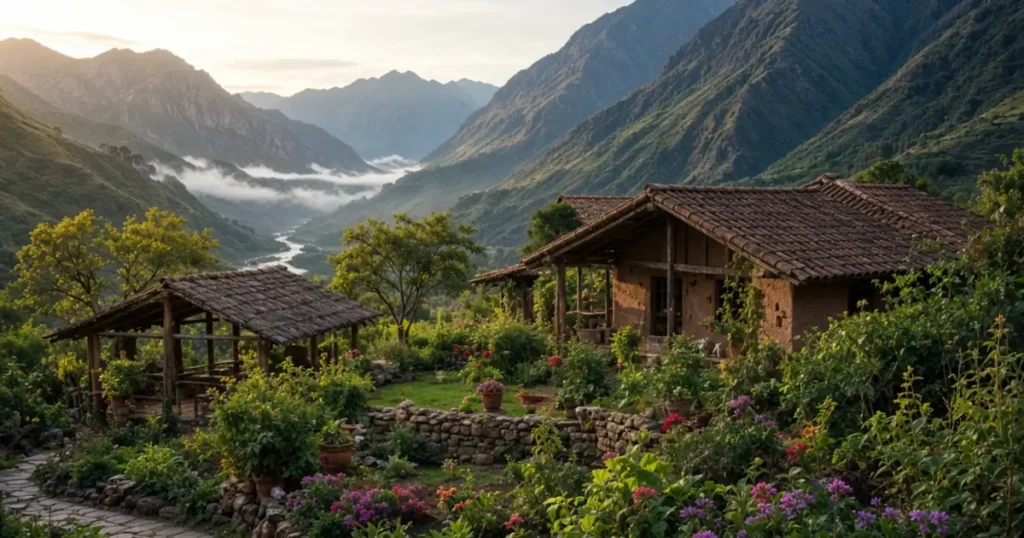
Why People With Insomnia Come Here Anyway
Most people who arrive with a sleep problem do not have a sleep disorder. They have anxiety or depression, and the sleep is the symptom they notice first.
That’s the route that has evidence behind it. It’s also our largest single group. 30% of guests give depression or anxiety as their reason for coming.
Of 320 guests with complete 3-month follow-up data, our average PHQ-9 depression score dropped 5.8 points. 71% held that improvement at 3 months. 13% showed no change. 16% improved and then partly slid back.
Those are our numbers, collected at intake, on day 11, and at 3 months. They’re observational, not a clinical trial, and the people who fill out a 3-month survey are not a random sample. I’d rather publish them with that caveat than not publish them.
We do not have sleep-specific outcome data. Nobody in this industry does. Until we have it, I am not going to put a sleep number on this page.
What I can give you is my own. My first ceremony was in March 2015, in Tomas’s family compound above Pisac, before any of this existed. I went back to my hostel the next morning and slept for 14 hours. That is one person, and it is not a rate.
If you want the actual first-line treatment for chronic insomnia, it isn’t us. The American College of Physicians’ 2016 clinical practice guideline puts cognitive behavioral therapy for insomnia first for every adult with chronic insomnia disorder. It works, it has no washout period, and it costs a fraction of a flight to Peru. If you have not tried it, try it before you try this.
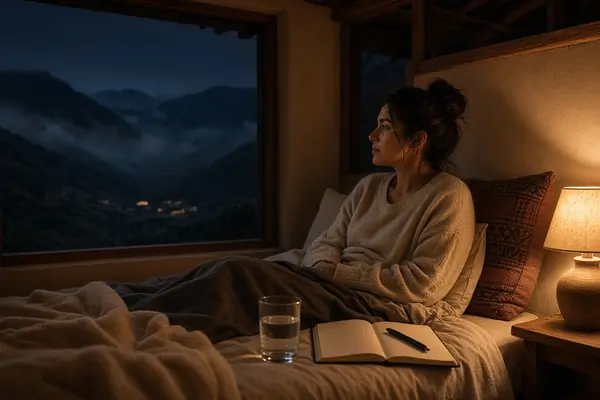
Sleeping At 3,100 Meters: The Part Nobody Tells You
Your sleep gets worse here before it gets better. That is physiology, not the medicine, and no ayahuasca website will tell you.
In a 2012 study in SLEEP, 16 mountaineers taken to 4,559 meters saw slow-wave sleep fall from 18% to 6% on the first night. Sleep efficiency fell from 93% to 69%. REM sleep was absent altogether on night 1. Their apnea-hypopnea index went from 0.1 to 60.9 events an hour, which is periodic breathing: your breathing cycles between deep and shallow and briefly stops, fragmenting sleep without you remembering waking up. By night 3, slow-wave sleep had recovered to 11% as their oxygen saturation came up.
We are at 3,100 meters, not 4,559. The effect here is much smaller. But it is the same effect, and it runs on the same clock: worst on night 1, better by night 3.
So here is what we built around it.
You have to be in the Sacred Valley 36 hours before the retreat starts. Not a suggestion. If you fly in from sea level and come straight up, you’ll spend your first ceremony fighting your own breathing instead of the medicine. The full timeline, medication review included, is in our guide to the eight weeks before you fly.
The first 2 days of the 11-day retreat have no ceremony in them at all. Coca tea, gentle walking, nothing demanding.
Dra. Rojas takes a pulse oximetry and blood pressure baseline on day 1. We keep 3 oximeters and 2 oxygen tanks on site. She has given supplemental oxygen during ceremony roughly 15 to 18 times in 9 years, usually for a minute or two, usually to someone short of breath after hard purging.
We didn’t start with this. In year 1, three guests got moderate altitude sickness and one went to hospital on day 2 before ever drinking. That’s what produced the protocol. Since early 2018, altitude incidents have been close to zero.
If you want the arithmetic on altitude before you book, we wrote a separate breakdown of Pisac versus Cusco elevation and what the difference does to your first 48 hours.
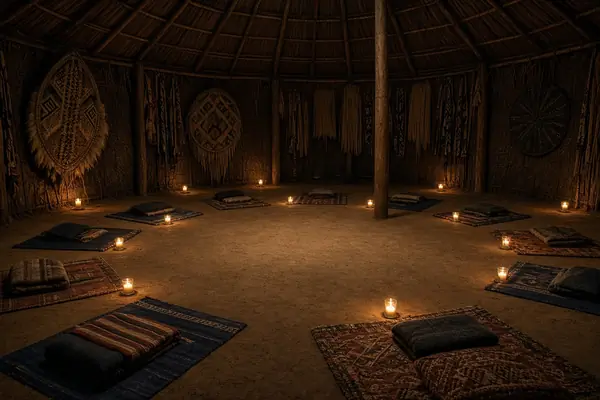
What The Night After Ceremony Actually Looks Like
A ceremony night is a partial sleep-deprivation event. We schedule around that fact instead of pretending it away.
The clock:
- 4:00 PM – last meal. Plain rice, boiled potatoes, no salt or oil.
- 7:15 PM – you take your mat in the maloca.
- 8:00 to 8:15 PM – medicine is served, one guest at a time.
- 8:45 PM to midnight – the peak. Three healers singing.
- Midnight to 2:00 AM – the deep stretch. Coldest part of the night, 3 to 5 degrees Celsius inside the maloca on a winter night.
- 3:00 AM – Tomas closes with a despacho offering.
- 3:00 to 3:30 AM – tea, water, then you walk back to your room.
Nobody wakes you the next morning. No alarms, no scheduled 7 AM anything. Breakfast is available from 7 AM if you want it. The integration circle is at 11 AM, and that gap is deliberate.
Then there are 4 ceremonies across 11 days, on nights 3, 5, 8 and 10. Never back to back. Tomas is firm on this: “The medicine needs time to settle. At altitude, the body is already working harder.”
Most centers run 5 to 7 ceremonies in a week. That schedule is built around what guests expect to get for their money, not around what the body can absorb. We run 4 and take longer doing it.
The practical consequence: across 11 days you will have 4 short nights and 7 normal ones, and you’ll be at altitude the whole time. Plan your flight home accordingly. The line we hear most often at the end of a retreat is that coming home was harder than going.

Dreams
Guests report vivid dreams after ceremony. That is consistent, and I have no measurement for it.
Given that the one sleep study found REM going down rather than up, I’m not going to explain the dreams by claiming ayahuasca boosts REM. I don’t know the mechanism. Neither does anyone else writing about it.
What I can tell you is what Tomas does with it. When someone drinks two nights running and feels nothing, his instruction is always the same: pay attention to your dreams. In the vegetalismo tradition he trained in for 15 years in the Ucayali, the dieta keeps working through sleep, and the dream is treated as part of the ceremony rather than an afterthought.
Bring a journal. It’s on the packing list, and most people end up using it at 5 AM rather than at the 11 AM circle.
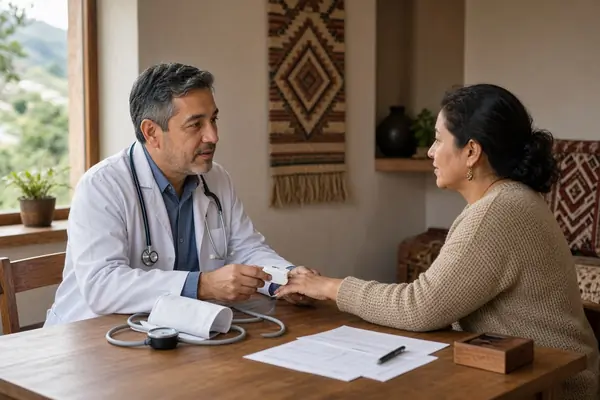
Who Should Not Come
This is where the sleep question gets serious, so I’m going to be direct.
If you have sleep apnea, this page is not for you. You will find retreat sites claiming ayahuasca improved someone’s apnea, sometimes with a testimonial from a CPAP user. There is no evidence for that. Obstructive sleep apnea is an airway problem. A plant medicine does not open an airway. And at 3,100 meters, where periodic breathing already fragments everyone’s sleep, an untreated apnea is worse, not better. Keep using your machine and talk to your sleep physician.
We turn away anyone with COPD or another significant respiratory condition, severe or uncontrolled asthma, uncontrolled hypertension, uncontrolled cardiac conditions, or a history of altitude sickness that required hospitalization. Some of those are standard everywhere. The respiratory and altitude ones are specific to working at this elevation.
We reject 13% of applicants outright. Another 6 to 8% get a conditional acceptance and never meet the conditions. Every applicant does a 30 to 45 minute video call with Diego before anything is confirmed, and Dra. Rojas reads every medical form.
On medication. SSRIs need a 6-week taper before ceremony, supervised jointly by your prescribing physician and our medical director. Fluoxetine needs 8 weeks because it clears slowly. If you’re taking an antidepressant for the depression that’s wrecking your sleep, that taper is the single hardest part of coming here, and some people should not do it. We wrote up what the research says about SSRIs and ayahuasca separately because it deserves more room than a paragraph.
One altitude-specific item most centers have never had to think about: acetazolamide, sold as Diamox, is what a lot of travelers take for altitude. It has to stop at least 48 hours before ceremony. We learned that in 2018 from a guest who didn’t mention it because she didn’t think of it as a real drug.
And one honest warning that has nothing to do with sleep and everything to do with the nights you’ll have. Guests tell us afterwards that they wish someone had told them the altitude would make the purging harder. The thinner air makes vomiting more physically taxing. It passes. It is still the thing people are least prepared for.
Frequently Asked Questions
Does ayahuasca help you sleep?
There is no evidence that ayahuasca treats a sleep disorder. The one polysomnography study, published in Psychopharmacology in 2008, found it suppressed REM sleep and raised slow-wave sleep pressure in 22 healthy men, without making their sleep quality worse. It was not a study of people with insomnia. Where guests report better sleep afterwards, the likely route is reduced anxiety and depression rather than a direct effect on sleep itself.
Will I sleep badly at 3,100 meters?
Probably, for the first 2 nights. Sleep at altitude shifts toward lighter stages, slow-wave sleep drops, and most newcomers develop periodic breathing at night. It improves as your oxygen saturation adjusts, usually by around night 3. This is why we require guests to be in the Sacred Valley 36 hours before the retreat starts and keep the first 2 days ceremony-free.
Can ayahuasca help with sleep apnea?
No. Obstructive sleep apnea is a physical airway condition and there is no evidence that ayahuasca affects it. Anyone claiming otherwise is guessing. At altitude an untreated apnea is more of a problem, not less. Keep using your CPAP and speak to your sleep physician.
What time does a ceremony end, and when do you sleep?
Ceremonies close at around 3 AM and guests are back in their rooms by 3:30. Nobody is woken the next morning, breakfast runs from 7 AM, and the integration circle is at 11 AM. There are 4 ceremonies across an 11-day retreat, on nights 3, 5, 8 and 10, so you get 7 undisturbed nights and 4 short ones.
Do people really get vivid dreams after ceremony?
Guests report it often and we have no measurement of it. Given that the only sleep study found REM sleep decreasing, we are not going to explain those dreams by claiming ayahuasca increases REM. Tomas treats dreams as part of the work and tells guests to pay attention to them, especially anyone who drinks two nights running and feels little.
I take an antidepressant for the depression that ruins my sleep. Can I come?
Only after a supervised taper. SSRIs require 6 weeks off before ceremony, and fluoxetine requires 8 because it clears slowly. That taper is supervised jointly by your prescribing physician and our medical director. For some people that taper is not a safe trade, and we will tell you so on the screening call.
If you’re weighing this because you cannot sleep, start with the screening call. It’s 30 to 45 minutes with Diego, and its job is to work out whether you should come at all. We say no to 13% of the people who ask.
Pisac Ayahuasca Retreats makes no medical claims. Ayahuasca is not a treatment for any condition and may not be brought into the United States. Every place is confirmed only after physician review.