
You can drink at the same retreat as an adult relative. You cannot bring a minor.
At our center above Pisac the floor is 25. The cap is 3 people from one family in the same retreat. And one of you can attend all 11 days without drinking anything.
Most pages on this subject sell the picture of a family healing together. This one gives you the rules, the published risk numbers, and the 3 cases where we tell people to come separately or not at all.

What The Research Actually Says About Ayahuasca And Family Relationships
No published study has measured what happens to a family that drinks ayahuasca together.
Nobody has run it. No controlled trial, no observational cohort, no survey of family pairs. Anyone telling you the research backs family retreats is stretching studies that measured individuals.
Here is what does exist, and where the evidence stops.
Perkins and colleagues published a naturalistic longitudinal study in Frontiers in Pharmacology in 2022. 53 people, assessed before ceremony and again at 7 days and 1 month. 55.6% scored a complete mystical experience on the MEQ-30. At 1 month the group reported lower depression, anxiety and stress, less alcohol and cannabis use, higher positive mood, and higher satisfaction with their relationships.
That last finding gets quoted constantly. Read it carefully. It is one person rating their own relationships on a questionnaire. No partner, parent or sibling was asked anything.
The closer study is Kettner and colleagues, 2021, also in Frontiers in Pharmacology. They followed 819 people across 5 timepoints through group psychedelic ceremonies, with 399 still reporting at 4 weeks. Social connectedness rose from 31.5 to 36.3 (Cohen’s d = 0.46). Wellbeing rose from 45.5 to 51.2 (d = 0.62). The sense of shared experience during the retreat predicted connectedness 4 weeks later.
Now the part nobody quotes. The strongest predictor of that shared-experience effect was facilitator rapport and emotional support inside the ceremony. Not the group. Not who you came with. The people running the room.
Group ceremony work is linked to lasting increases in how connected people feel, measured on real scales, at 4 weeks. Whether that transfers to the specific relative lying 3 meters away from you has never been tested.
We built the rest of this page on that gap.
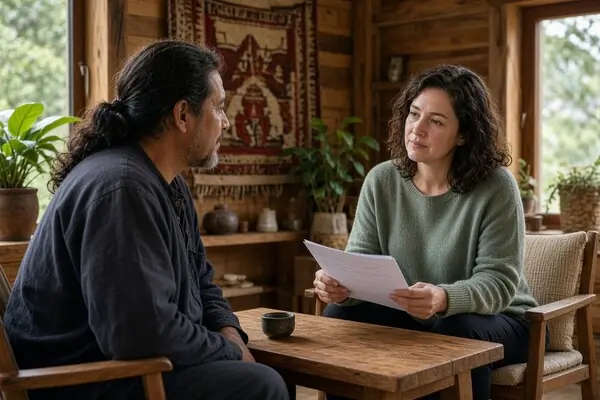
Who Can Come Together, And Who Cannot
Minimum age is 25.
That rules out the most common version of the question we get, which is a parent wanting to walk a teenager through something. We do not do it. A center that says yes to that is telling you something about the rest of its screening.
We do not accept pre-formed groups larger than 3. The 11-day ayahuasca retreat takes 12 guests at most. Four or more from one household changes the room for everyone else in it.
Every person applies separately through the same application form. Every person does their own 30 to 45 minute video call with Diego Mendoza, our senior facilitator. Every medical form is reviewed by Dra. Carmen Rojas Vargas within 72 hours. One of you getting accepted does not carry the other in.
Diego has rejected applicants on the video call who submitted clean written applications.
We reject 13% of applicants outright. Another 6 to 8% get a conditional yes and never meet the conditions. So 19 to 21% of people who apply never sit in the maloca.
That matters more when you apply as a pair. Sometimes one of you is in and one is not.
There is also an altitude layer that lowland centers do not have. We sit at 3,100 meters. Uncontrolled hypertension, severe or uncontrolled asthma, COPD, and any history of altitude sickness that required hospitalization are automatic disqualifications here. At a jungle center at sea level, some of those would not be.
If one of you is disqualified, there is a third route. A companion guest attends the full 11 days, follows the same food dieta, sits in the integration circles, takes the plant baths, receives healer consultations, and may observe ceremony from the maloca without drinking. The rate is $2,400, and the companion counts toward the 12-guest capacity.
Three Ways To Do This, And What Each One Costs You
Most people arrive thinking there is one decision. There are three.
| Same retreat, both drinking | Separate retreats | One drinks, one companions | |
|---|---|---|---|
| What it looks like | Both apply, both screened, both in the maloca on nights 3, 5, 8 and 10 | You take one date, they take another. We run 2 retreats a month and publish dates 12 months out. | One of you drinks 4 times. The other does all 11 days without the medicine. |
| What you get | A shared reference point. You both know what the cold at 2 AM feels like. The integration circles cover the same nights. | Full independence. Neither experience is shaped by the other being in the room. | Someone who was in the room, sober, for all 4 nights, and who followed the same dieta the whole time. |
| What you give up | Some privacy. You will hear each other at your worst and you cannot respond. | The shared reference point. You will be describing it to each other, not remembering it together. | The companion does not get the ceremony work. That is a real loss if they wanted it. |
| Cost per person | $3,000 private room, or $2,400 each in a shared room | $3,000 each | $3,000 drinking, $2,400 companion |
| Best for | Adult siblings. Couples. A parent and adult child who already talk straight. | Anyone where one person is uncertain. Anyone with a live conflict between them. | A medical disqualification. A partner who wants to be there without participating. |
The companion route is the one nobody advertises. It is the answer when one of you cannot clear the medical screening and both of you still want to go.
What Happens When You Are Both In The Room
You will not speak to each other. Not once, for the whole night.
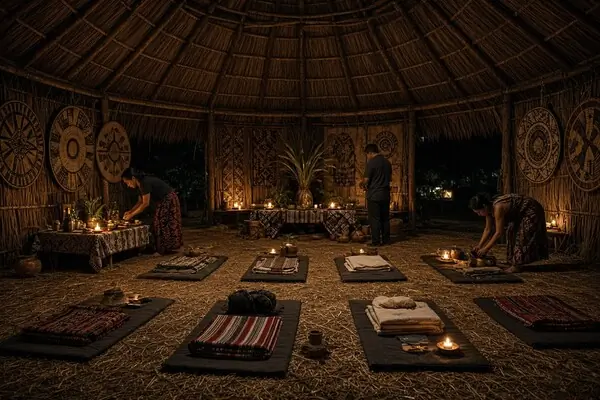
The rules are identical for relatives and strangers. Stay on your mat. Purge into your bucket. No talking. No touching another guest. Keep your blanket on, which is a circulation rule at this altitude, not a comfort one.
Maestro Tomas Quispe Huaman assigns every mat at the start of the retreat. The placement comes from the coca leaf reading he does with each guest on Day 2. You do not choose where you lie down, and neither does your relative.
Ceremony opens at 7:45 PM and Tomas closes it at 3 AM. In the room: three healers and 2 facilitators for a maximum of 12 guests. That is 2.4 guests per staff member. Ask any center you are comparing us to for their number.
Here is the part people do not picture in advance.
At some point your mother, or your brother, is going to be sick, or crying, or making a sound you have never heard them make. You will hear it in the dark. You will not be allowed to go to them.
A facilitator reaches them first, kneels at the mat and makes verbal contact. Then a healer comes and sings directly to them. Physical contact only with spoken consent, asked for in the moment, every time.
That is the protocol, across more than 700 ceremonies. Yours, that night, is to stay on your mat.
The Risk Numbers Nobody Puts On A Page Like This
Adverse effects are common, not rare.
The largest dataset on this is the Global Ayahuasca Survey, published by Bouso and colleagues in PLOS Global Public Health in 2022. Of 8,216 respondents, 69.9% reported acute adverse physical effects. 2.3% needed medical attention afterward. Vomiting or nausea hit 62%. Headache, 17.8%.
On the mental side, 7,839 answered. 55.9% reported adverse mental health effects in the weeks or months after drinking. Around 12% sought professional support for them. Around 88% considered those effects part of a positive process of growth.
Read those two together. More than half of people go through a hard stretch afterward, and most of them think it was worth it. Both are true, and a page that only prints the second half is selling you something.
Our own record across 9 years, 2,100 guests and more than 700 ceremonies: zero deaths, one medical evacuation that resolved with full recovery, zero incidents of sexual or physical misconduct, zero lawsuits.
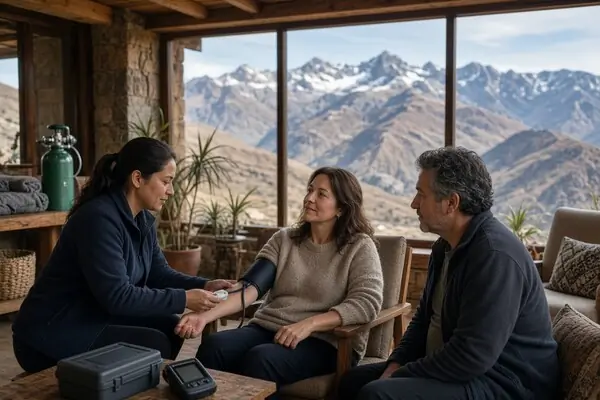
Dra. Rojas has given supplemental oxygen during ceremony roughly 15 to 18 times in those 9 years, almost always for breathing difficulty during heavy purging. It resolves on site within minutes.
The altitude is the variable nobody warns you about, and what the elevation changes starts before the medicine does. Onset here is faster, typically 15 to 20 minutes rather than 30 to 45. Purging is harder, because your body is already working to breathe at 3,100 meters. The hospital is 45 minutes away by road, which beats the best-case boat transit at most jungle centers.
Every guest arrives in the Sacred Valley at least 36 hours before Day 1. The first 2 days of the retreat carry no ceremony at all. That protocol exists because 3 guests got altitude sickness in our first year. One went to hospital on Day 2, before drinking anything.
When Bringing A Family Member Is The Wrong Call
Three cases. In all three we tell people to come separately, or not at all.
One of you is doing the convincing. If you found this page and they are coming along, do not book it. Diego asks about this directly on the video call and he has turned people down over it. The medicine does not work on someone who was talked into it. You will spend your own 4 ceremonies managing their retreat instead of doing yours.
There is a live conflict you are hoping the medicine will settle. It will not settle it. It will open it, at 2 AM, in a cold room, with 10 strangers present and neither of you permitted to speak. That is a bad place to start a conversation you have been avoiding for 20 years. Do the conversation first, sober, at home. Then decide.
One of you has harmed the other. Abuse inside a family is not a case for a shared ceremony, at any age, at any center. It is a case for separate work with clinicians trained for it. We say no to this one and we do not negotiate on it.
How To Ask Them
Most pairs get this wrong in the first conversation. Here is the script we give people who ask us.
Say what it is for you, not what it will do for them.
“I have booked this for me. Here is what I am hoping to work on.”
Give them the exit before they have to find it.
“I would rather go alone than have you come because I asked. If it is not yours, say no and nothing changes between us.”
Name the cost in real numbers, early.
11 days. $3,000. 4 ceremonies. Two weeks off alcohol, red meat, pork, fermented food and cannabis before you fly. A 6-week supervised taper if they are on an SSRI, 8 weeks for fluoxetine.
Send the disqualification list before the pitch.
Lithium is an absolute contraindication. So is a bipolar I diagnosis, a psychosis history, and uncontrolled hypertension. Finding that out after 3 weeks of conversation wastes everyone’s time.
Then leave it alone for a week.
Integration When You Go Home To The Same House
Integration circles are group sessions. Everyone in the retreat is in the room, and what gets said there stays in the room.
Every guest also gets at least 2 individual consultations with a healer during the 11 days, on Day 4 and Day 9. If there is something you do not want said in front of your relative, that is where it goes.
Puente Andino, our integration program, covers the 12 months after you fly home. A video call at Week 1, another at Week 3, an email with an optional call at Month 2, then check-ins at 6 and 12 months. About 85% of guests take the Week 1 call.
Laura Sinclair runs it. She was a registered psychotherapist with the Ontario College of Psychotherapists, trained in somatic experiencing, IFS and EMDR, with 7 years of clinical practice before joining in 2020. She has more than 650 hours facilitating ceremony here.
If you are going home to the same house, ask for separate Week 1 calls.
What It Costs
$3,000 per person for the 11-day retreat in a private room.
$2,400 per person in a shared room, which is the rate for 2 people who want to be housed together. Companion guest is also $2,400.
Included: airport pickup and drop-off, ground transfer, all meals, 4 ayahuasca ceremonies, your coca leaf reading, all plant baths, every integration circle, individual healer consultations, and the full Puente Andino program.
Not included: international flights, the domestic flight into the Sacred Valley (roughly $80 to $130 return), travel insurance, which is required, and your hotel for the 36 hours of acclimatization before Day 1.
50% deposit, balance due 30 days out. A 3-month payment plan is available.
Cancel 60 or more days out and you get everything back minus a $200 administrative fee.
Questions People Ask Before They Book As A Pair
Can I bring my teenage son or daughter?
No. Our minimum age is 25.
Will we be in the same ceremony?
Yes. All guests in a retreat sit in the same maloca on the same 4 nights, which are nights 3, 5, 8 and 10 of the 11 days. Maestro Tomas assigns mat placement from the coca leaf reading he does with each guest on Day 2.
Can we share a room?
Yes. We have 2 shared rooms for couples, siblings or friends, at $2,400 per person instead of $3,000. The other 10 rooms are private.
What happens if one of us is accepted and the other is not?
Each application is decided on its own. We reject 13% of applicants outright and another 6 to 8% never meet their conditions, so 19 to 21% of applicants never attend. Discuss it before you both apply.
Can my partner come without drinking?
Yes. A companion guest attends all 11 days, follows the same food dieta, joins integration circles, receives plant baths and healer consultations, and may observe ceremony from the maloca without taking the medicine. The rate is $2,400 and the companion counts toward the 12-guest capacity.
Will my family member hear what I say in the integration circle?
Integration circles are group sessions and everyone in the retreat is present. What is said in the circle is confidential to the room. Every guest also gets individual healer consultations on Day 4 and Day 9.
Is ayahuasca safe at 3,100 meters?
The altitude adds real risk and we screen for it. Uncontrolled hypertension, severe or uncontrolled asthma, COPD and any history of altitude sickness requiring hospitalization are automatic disqualifications here. Every guest arrives at least 36 hours early, the first 2 days carry no ceremony, and Dra. Rojas is on site for every ceremony block.
How far ahead do we need to book?
Retreats between June and September often sell out 5 to 7 months ahead. December to March may have availability 2 to 3 months out. We publish dates 12 months in advance and run 2 retreats a month.
What if we need space from each other during the retreat?
Tell Laura Sinclair or Diego Mendoza. Every guest gets individual healer consultations on Day 4 and Day 9, and the afternoons on non-ceremony days are deliberately unstructured. Any guest can also sit out any ceremony, for any reason, with no pressure.
Pisac Ayahuasca Retreats makes no medical claims. Ayahuasca is not a treatment for any condition and may not be brought into the United States. Every place is confirmed only after physician review.